
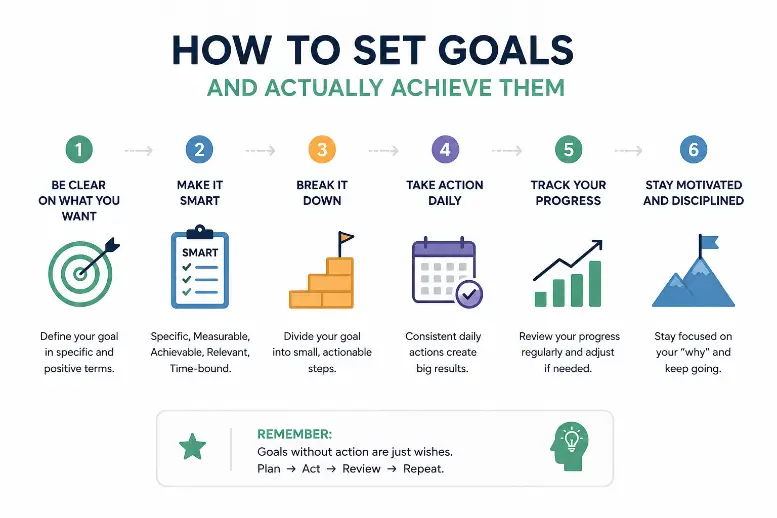
How to Set Goals and Actually Achieve Them can feel more complicated than it needs to be. The useful approach is to turn the goal into a small number of decisions you can act on today. This guide explains how to set goals in practical terms, with examples, common mistakes, and a simple plan you can adapt to your situation.
What You Need to Know First
Personal development works best when advice is specific enough to test. You do not need a perfect routine. You need a realistic behavior, a supportive environment, and a way to notice whether the change is helping.
Define the Problem More Precisely
“I need more discipline” is too broad to act on. Identify the behavior you want to change, when it usually happens, and what gets in the way. A precise target such as “work on the report for 25 minutes before checking messages” gives you something observable to practice.
Example: Instead of trying to change everything at once, choose one measurable action related to how to set goals. Test it for a week, review the result, and adjust the next step based on evidence.
Reduce Friction for the Right Behavior
Environment often beats willpower. Put distracting devices out of reach, close unnecessary tabs, prepare materials in advance, and make the first step obvious. At the same time, make unwanted behaviors slightly harder. Even a small amount of friction can interrupt an automatic habit long enough for you to choose differently.
Example: Instead of trying to change everything at once, choose one measurable action related to how to set goals. Test it for a week, review the result, and adjust the next step based on evidence.
Work in Manageable Blocks
Long, heroic sessions are not required for meaningful progress. Use a focused block with one defined outcome, then take a genuine break. The ideal duration varies by person and task, so experiment rather than treating one productivity technique as a universal rule.
Example: Instead of trying to change everything at once, choose one measurable action related to how to set goals. Test it for a week, review the result, and adjust the next step based on evidence.
Protect Sleep, Energy, and Recovery
Concentration and self-control are harder when you are exhausted or chronically stressed. Regular sleep, movement, meals, daylight, and breaks are not productivity hacks; they are basic conditions that support attention and decision-making. Persistent difficulty with attention, mood, or daily functioning may warrant a conversation with a qualified health professional.
Example: Instead of trying to change everything at once, choose one measurable action related to how to set goals. Test it for a week, review the result, and adjust the next step based on evidence.
Track Behavior, Not Motivation
Motivation changes from day to day. A simple record of whether you completed the intended behavior gives you better feedback. Review patterns weekly: What time worked? What triggered distraction? Was the task too large? Use the answers to redesign the system instead of judging yourself.
Example: Instead of trying to change everything at once, choose one measurable action related to how to set goals. Test it for a week, review the result, and adjust the next step based on evidence.
Common Mistakes to Avoid
Avoid changing ten habits at once, building an elaborate system before doing the work, relying on motivation alone, and confusing busyness with progress. Another common mistake is using productivity advice to remove every moment of rest. Sustainable improvement includes recovery and room for ordinary life.
A Seven-Day Reset
Choose one priority for the week. Define a daily minimum that feels almost too easy, schedule it, remove one predictable distraction, and record completion. At the end of seven days, keep what worked and change what did not. The aim is not a perfect week; it is a system you can repeat.
Frequently Asked Questions
What is the best way to start with how to set goals?
Start with the smallest action that produces useful information or progress. Make it measurable, put it on your calendar, and review the result before adding complexity.
How long does it take to see results?
There is no universal timeline. Results depend on your starting point, resources, consistency, and the goal itself. Focus on leading indicators you can control rather than expecting an instant outcome.
What should I do if the first approach does not work?
Treat the result as feedback. Identify the specific obstacle, change one variable, and test again. A failed tactic does not necessarily mean the overall goal is wrong.
Final Thoughts
How to Set Goals and Actually Achieve Them is easier when you replace vague intentions with a small system: understand the starting point, choose a realistic next action, measure what happens, and improve from there. Use the ideas above as a framework, then adapt them to your own constraints and goals.