
Starting a business without a plan can feel like driving to an unfamiliar destination without a map. You may eventually get there, but you are far more likely to waste time, money, and energy along the way.
So, what is a business plan? Simply put, it is a written document that explains what your business does, who it serves, how it will make money, how it will operate, and what you want to achieve.
A good business plan is not just paperwork for a bank or investor. It can become a practical roadmap for making decisions, managing expenses, understanding your market, and measuring progress. The U.S. Small Business Administration describes a business plan as a foundation and roadmap for structuring, running, and growing a business. (legacy.sba.gov)
Whether you’re starting a business, opening a local shop, launching an online company, or expanding an existing operation, learning how to write a business plan can make your next steps much clearer.
What Is a Business Plan?
A business plan is a detailed description of how your company will operate and generate revenue.
It typically explains:
- What your business sells
- Who your target customers are
- What problem you solve
- How you will reach customers
- How much you expect to spend
- How you will generate revenue
- Who will manage the business
- What your short- and long-term goals are
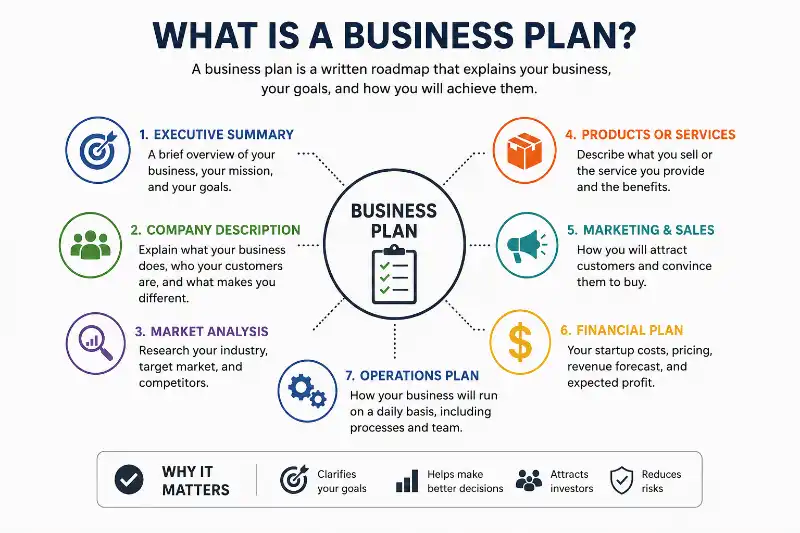
Business Development Bank of Canada (BDC) notes that a business plan generally covers areas such as the company profile, sales and marketing, operations, and financial information. (BDC.ca)
Think of it this way:
Business idea: “I want to open a coffee shop.”
Business plan: “I will open a speciality coffee shop for remote workers and university students, located near a busy transport area. Customers will be attracted through competitive pricing, high-speed Wi-Fi, loyalty programmes, and social media marketing.”
The second version gives you something to work with. It identifies the customer, location, offer, marketing strategy, and basic business model.
Why Is a Business Plan Important?
A business plan is important because it forces you to turn a general idea into a practical business model.
It Gives Your Business Direction
One of the biggest advantages of writing a business plan is clarity.
When everything exists only in your head, it is easy to change direction every few weeks. One day you may want to sell products online; the next, you may want to open a physical shop.
Writing your goals down forces you to answer important questions:
- What exactly am I selling?
- Who is my customer?
- Why would they choose me?
- How will I reach them?
- What will it cost?
- How will I make money?
The SBA recommends using a business plan as a roadmap for starting, managing, and growing a company. (legacy.sba.gov)
It Helps You Understand Your Market
A strong business plan requires market research.
Suppose you want to launch a real estate business plan for a property management company. Before investing money, you should understand:
- The local property market
- Your ideal property owners
- Competitors
- Average management fees
- Demand for rental properties
- Customer acquisition costs
This research may reveal that your original idea needs to change.
For example, you might discover that there are already 20 property management companies competing for traditional landlords. However, there may be an underserved market for short-term rental management.
That insight could completely change your strategy—and potentially improve your chances of success.
It Helps You Manage Money
Many businesses fail because the owner understands the product but doesn’t understand the numbers.
Your business plan should estimate:
- Startup costs
- Monthly operating expenses
- Pricing
- Expected sales
- Revenue
- Cash flow
- Profit margins
For example, imagine you’re creating a coffee shop business plan.
You estimate that your monthly fixed costs are £8,000. Your average customer spends £6, meaning you need approximately 1,334 transactions just to generate £8,000 in sales before considering other variable costs.
That simple calculation immediately raises important questions:
Can the location generate enough customers? Is the average order value realistic? Should you increase prices or reduce costs?
This is one of the main reasons how to make a business plan is more than simply filling out a template.
What Should a Business Plan Include?
There is no single format that works for every company. The SBA identifies two common approaches: traditional business plans and lean startup plans. Traditional plans are more detailed, while lean plans focus on the most important information and can be much shorter. (legacy.sba.gov)
A traditional small business plan commonly includes the following sections.
Executive Summary
The executive summary provides a short overview of your business.
It should explain:
- What your company does
- Your main product or service
- Your target market
- Your competitive advantage
- Your major goals
Although it appears first, many entrepreneurs find it easier to write this section after completing the rest of the plan.
Company Description
Explain what your business does and what makes it different.
For example:
“We provide affordable website design services for independent restaurants that need professional websites but cannot afford large agencies.”
That’s much more useful than simply saying:
“We are a web design company.”
Market Analysis
This section demonstrates that you understand your customers and competitors.
Include information about:
- Target audience
- Industry trends
- Customer needs
- Competitors
- Market opportunities
- Potential challenges
The goal isn’t to prove that your idea is perfect. It’s to demonstrate that you’ve investigated the market and understand where your business fits.
Products or Services
Explain exactly what you’re selling.
Describe:
- Features
- Benefits
- Pricing
- Delivery
- What makes your offer different
Always focus on the customer’s problem rather than simply listing product features.
Marketing and Sales Strategy
How will people discover your business?
Your strategy might include:
- SEO
- Social media
- Email marketing
- Paid advertising
- Local search
- Partnerships
- Referral programmes
- Content marketing
For example, a local bakery might use Instagram and Google Business Profile optimisation to attract nearby customers, while an online software company might rely heavily on SEO and content marketing.
Financial Plan
This is one of the most important parts of writing a business plan.
Include realistic estimates for:
- Startup expenses
- Revenue
- Operating costs
- Cash flow
- Break-even point
- Funding requirements
Don’t simply choose numbers that make the business look profitable. Your projections should be based on reasonable assumptions.
If you’re seeking financing, detailed financial projections can also help lenders and investors evaluate your business. The SBA specifically recommends financial projections alongside funding requests. (legacy.sba.gov)
How to Write a Business Plan Step by Step
If you’re wondering how to create a business plan, don’t try to write 30 pages in one sitting.
Start with these steps.
Step 1: Define Your Business
Write down what you sell, who you serve, and what problem you solve.
Step 2: Identify Your Target Customer
Be specific.
Instead of saying “everyone,” define your ideal customer by factors such as age, location, income, interests, profession, or buying behaviour.
Step 3: Research Competitors
Identify at least three competitors and analyse their:
- Pricing
- Products
- Marketing
- Strengths
- Weaknesses
- Customer reviews
Step 4: Define Your Business Model
Explain exactly how the company will make money.
Will you sell products, subscriptions, services, memberships, advertising, or a combination?
Step 5: Calculate Your Costs
List one-time expenses and recurring monthly expenses.
This could include equipment, software, rent, salaries, marketing, insurance, inventory, and professional services.
Step 6: Create Financial Projections
Estimate sales and expenses based on realistic assumptions.
Don’t confuse revenue with profit. If your business generates £10,000 in sales but spends £8,500 operating it, your profit before other applicable costs is only £1,500.
Step 7: Set Measurable Goals
Instead of writing:
“We want to grow quickly.”
Write:
“We aim to acquire 100 paying customers during our first 12 months.”
Specific goals are easier to measure and manage.
Do You Need a Business Plan for a Small Business?
Not every entrepreneur needs a lengthy document.
If you’re starting a simple freelance business, for example, a one-page small business plan may be enough to clarify your target customers, services, pricing, marketing channels, costs, and revenue goals.
On the other hand, if you’re applying for a large loan or approaching investors, a more detailed traditional plan may be appropriate.
The important thing is usefulness—not page count.
The SBA notes that lean startup plans can focus on key elements and may be as short as one page, while traditional plans can be considerably more detailed. (legacy.sba.gov)
Common Business Plan Examples
Different industries require different approaches.
A real estate business plan might focus on property acquisition, rental income, management fees, market trends, and property-related expenses.
A coffee shop business plan could focus on location, foot traffic, menu pricing, suppliers, staffing, equipment, and daily sales targets.
An online consulting business might instead focus on service packages, client acquisition, personal branding, content marketing, and recurring contracts.
The structure may be similar, but the numbers, customers, risks, and strategy will be completely different.
Common Mistakes to Avoid
When learning how to write a business plan, avoid these common mistakes:
- Making unrealistic revenue predictions
- Ignoring competitors
- Targeting everyone
- Underestimating startup costs
- Focusing only on the idea
- Creating a plan and never reviewing it
- Using complicated language instead of clear explanations
Your business plan should be a working document. As your market, customers, and financial situation change, your plan should change too.
The SBA also emphasises that business planning can be an ongoing process rather than a document that is written once and forgotten. (Small Business Administration)
Frequently Asked Questions
What is a business plan in simple terms?
A business plan is a written roadmap explaining what your business does, who it serves, how it will make money, and how you plan to grow it.
How long should a business plan be?
There is no universal length. A lean plan may fit on one page, while a traditional plan can be many pages long. The right length depends on the complexity of your business and who will read it. (legacy.sba.gov)
How do I write a business plan for the first time?
Start with your business idea, target customer, competitors, products or services, marketing strategy, operating costs, revenue model, and financial projections. You can then organise this information into a traditional or lean format.
Can I create a business plan without an accountant?
Yes. You can prepare the basic plan yourself. However, if your business involves significant investment, complex tax issues, loans, or financial projections, professional accounting or financial advice can be valuable.
Is a business plan necessary when starting a business?
It isn’t always legally required, but it can be extremely useful. A business plan helps you test your assumptions, organise your strategy, manage finances, and communicate your idea to potential lenders or investors.
Final Thoughts
A business plan isn’t about predicting the future perfectly. It’s about thinking through the future before you invest your time and money.
Whether you’re developing a real estate business plan, creating a coffee shop business plan, or preparing a simple plan for a home-based company, the goal is the same: understand what you’re building, who you’re building it for, how it will operate, and how it will make money.
If you’re starting a business, don’t wait until everything is perfect. Start with a simple version, research your market, write down your assumptions, calculate your numbers, and improve the plan as you learn.
The best business plan isn’t necessarily the longest one. It’s the one you actually use.
Sources
- U.S. Small Business Administration – Write Your Business Plan SBA Business Plan Guide
- U.S. Small Business Administration – Plan Your Business SBA Plan Your Business
- Business Development Bank of Canada – How to Write an Effective Business Plan BDC Business Plan Guide
- U.S. Small Business Administration – Four Questions Every Effective Business Plan Should Answer SBA Business Plan Questions
- U.S. Small Business Administration – Sample Business Plans SBA Sample Business Plans