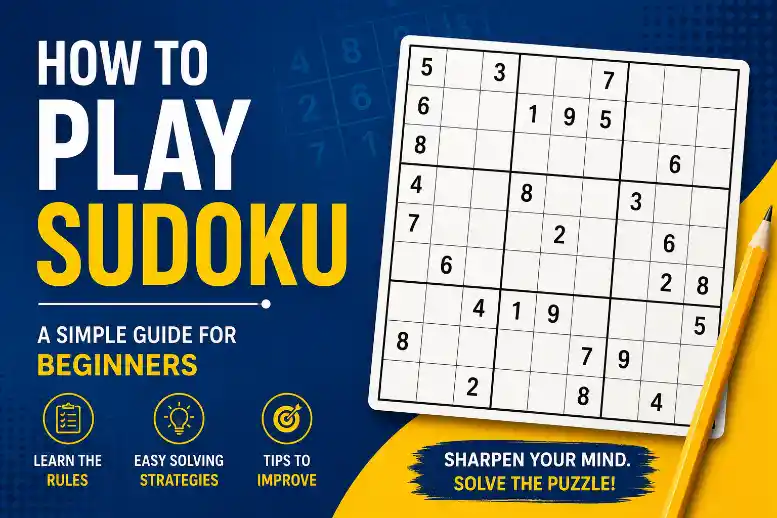
Sudoku is one of the world’s most popular logic puzzles, enjoyed by millions of people every day. Unlike crossword puzzles or word games, Sudoku doesn’t require math skills or a large vocabulary. Instead, it challenges your logical thinking, pattern recognition, and problem-solving abilities.
If you’ve ever looked at a Sudoku puzzle and wondered where to begin, you’re not alone. At first glance, the grid can seem confusing, but once you understand the basic rules and a few simple strategies, solving Sudoku becomes both enjoyable and addictive.
In this guide, you’ll learn exactly how to play Sudoku, along with practical techniques that beginners can use to solve puzzles more quickly and accurately.
What Is Sudoku?
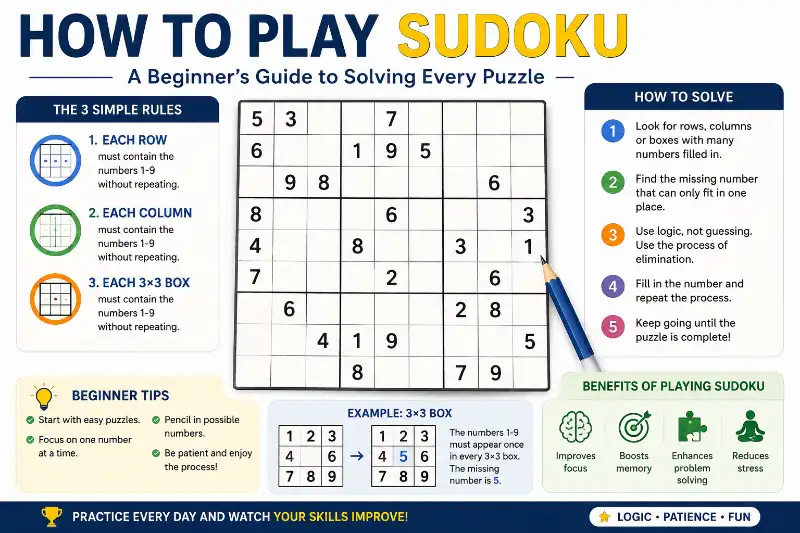
Sudoku is a number puzzle played on a 9×9 grid, which is divided into nine 3×3 boxes.
Some numbers are already filled in when you begin. Your goal is to fill every empty square using the numbers 1 through 9 while following three simple rules.
Unlike what many people think, Sudoku is not a math game. You never add, subtract, multiply, or divide numbers. Success depends entirely on logical reasoning.
The Three Basic Rules of Sudoku
Every Sudoku puzzle follows these simple rules:
Rule 1: Every Row Must Contain the Numbers 1–9
Each horizontal row must include every number from 1 to 9 exactly once.
For example, if a row already contains the numbers 1, 2, 3, 5, 6, 7, 8, and 9, the missing number must be 4.
Rule 2: Every Column Must Contain the Numbers 1–9
Each vertical column also needs every number from 1 to 9 without repeating.
If a column already has eight different numbers, you can often determine the missing one immediately.
Rule 3: Every 3×3 Box Must Contain the Numbers 1–9
Each smaller 3×3 section must also contain every number exactly once.
Many beginners solve Sudoku by checking each box first because it limits the possible numbers significantly.
How to Start Solving Sudoku
The easiest way to begin is by looking for rows, columns, or boxes that already contain many numbers.
Suppose one 3×3 box contains:
- 1
- 2
- 3
- 4
- 6
- 7
- 8
- 9
Only one number is missing.
Since the numbers 1 through 9 must all appear exactly once, the missing number is 5.
Continue looking for similar opportunities across the puzzle before attempting more difficult sections.
7 Easy Sudoku Strategies for Beginners
1. Scan Rows and Columns
Look for rows or columns that already have six, seven, or eight numbers filled in.
The fewer missing numbers there are, the easier it is to determine what belongs in the empty spaces.
2. Focus on One Number at a Time
Instead of trying to solve everything at once, choose a single number—such as 1—and search the entire puzzle for places where it can legally fit.
Repeat the process with the remaining numbers.
This technique makes patterns easier to spot.
3. Use the Process of Elimination
If a square could contain several numbers, eliminate impossible options.
For example:
- The row already contains 3
- The column already contains 7
- The 3×3 box already contains 5
Those numbers cannot be placed in that square, reducing your choices.
4. Complete Easy Boxes First
Don’t jump into the hardest part of the puzzle immediately.
Instead, solve the sections that already contain the most numbers.
Every completed square creates new clues elsewhere.
5. Avoid Guessing
Many beginners start guessing when they get stuck.
Good Sudoku solving relies on logic rather than luck.
If you’re unsure about a number, move to another area of the puzzle and return later.
6. Pencil In Possible Numbers
Many Sudoku apps and newspapers allow players to write small candidate numbers inside empty cells.
For example, an empty square might contain:
- 2
- 4
- 8
As you solve more of the puzzle, you’ll eliminate possibilities until only one number remains.
7. Practice Regularly
Like any skill, Sudoku becomes easier with experience.
After solving a few beginner puzzles, you’ll naturally recognize patterns much faster.
Many experienced players can complete easy puzzles in under ten minutes simply because they’ve developed strong logical habits.
Common Mistakes Beginners Make
Even experienced players occasionally make mistakes, but beginners often struggle with the same issues.
Some common mistakes include:
- Guessing instead of using logic
- Forgetting to check both rows and columns
- Ignoring the 3×3 boxes
- Filling numbers too quickly
- Overlooking duplicate numbers
Whenever you place a number, quickly verify that it doesn’t already appear in the same row, column, or box.
Taking a few extra seconds can prevent larger mistakes later.
Benefits of Playing Sudoku
Sudoku is more than just entertainment.
Research suggests that regularly solving logic puzzles may help improve cognitive skills such as concentration, memory, and problem-solving.
Some benefits include:
- Better logical thinking
- Improved concentration
- Enhanced pattern recognition
- Stronger memory
- Reduced stress through mindful focus
Many people enjoy solving a Sudoku puzzle each morning as part of their daily routine.
Tips to Solve Sudoku Faster
Once you’ve mastered the basics, these habits can improve your speed:
- Start with the easiest sections.
- Look for obvious missing numbers first.
- Scan the puzzle repeatedly.
- Use candidate notes wisely.
- Stay patient and avoid rushing.
Remember, speed comes naturally with practice. Accuracy is more important than finishing quickly.
Frequently Asked Questions
Is Sudoku a math game?
No. Sudoku uses numbers, but it doesn’t involve arithmetic. The puzzle is based entirely on logical reasoning.
Can beginners learn Sudoku easily?
Yes. Most beginners understand the rules within a few minutes and improve quickly through regular practice.
What happens if I make a mistake?
A single incorrect number can affect multiple rows, columns, and boxes. If you become stuck, review your recent moves and look for duplicates.
How long does it take to solve a Sudoku puzzle?
An easy puzzle may take beginners between 15 and 30 minutes. Experienced players often complete easy puzzles in less than 10 minutes.
Does playing Sudoku improve brain function?
While Sudoku isn’t a guarantee of better memory or intelligence, research suggests that mentally stimulating activities can help maintain cognitive skills such as attention, reasoning, and problem-solving.
Final Thoughts
Learning how to play Sudoku is much easier than it first appears. Once you understand the three basic rules and begin applying logical strategies instead of guessing, each puzzle becomes an enjoyable challenge.
Start with beginner-level puzzles, practice consistently, and don’t worry about solving every puzzle quickly. Over time, you’ll recognize patterns more easily, make fewer mistakes, and develop greater confidence in your solving abilities.
Whether you play for relaxation, mental exercise, or simply to pass the time, Sudoku is a rewarding hobby that keeps your brain engaged.
Sources
- World Puzzle Federation – Sudoku Rules and Puzzle Resources
https://www.worldpuzzle.org/ - Sudoku.com – Beginner Guide to Sudoku
https://sudoku.com/how-to-play/sudoku-rules-for-complete-beginners/ - The New York Times Games – Sudoku Help
https://www.nytimes.com/puzzles/sudoku - National Institute on Aging – Cognitive Health and Brain Activities
https://www.nia.nih.gov/health/cognitive-health-and-older-adults - Harvard Health Publishing – Keeping Your Brain Healthy
https://www.health.harvard.edu/topics/brain-health
